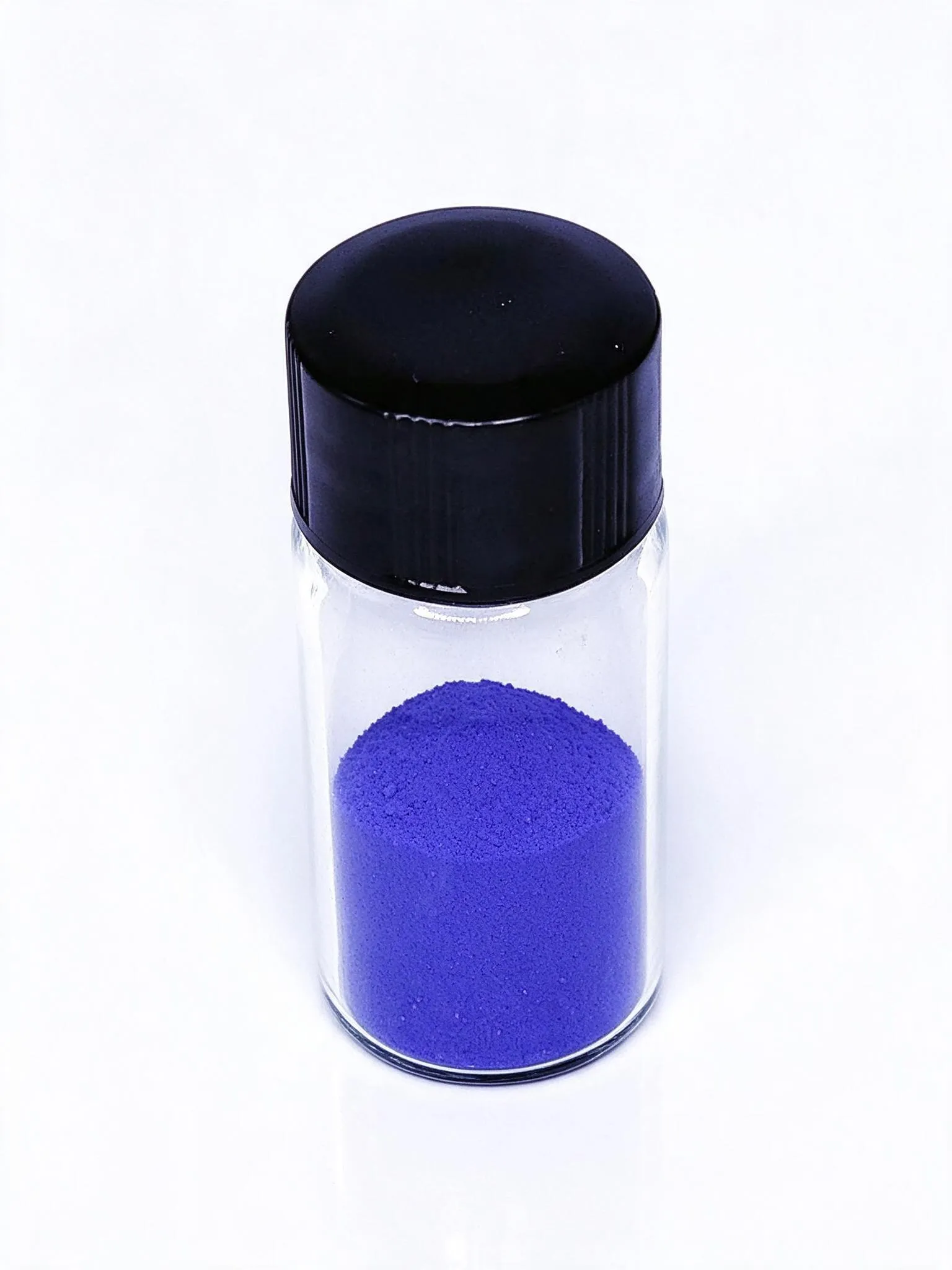
Formulating with GHK-Cu (Copper Tripeptide-1) is one of the most rewarding yet technically sensitive tasks in modern cosmetic chemistry. While pure GHK-Cu Powder is highly stable in its dry crystalline state (24-month shelf life at 2–8 °C), once dissolved in an aqueous serum or emulsion, the coordination bond between the GHK tripeptide ligand and the Cu²⁺ ion is governed by strict pH, redox, and chelation equilibria.
If a copper peptide serum turns from vibrant sapphire-violet to pale green, murky brown, or colorless during accelerated stability testing (40 °C / 75% RH), the root cause is almost always one of four preventable formulation mistakes. Below is our complete laboratory handling, formulation compatibility, and storage protocol—summarized from our Downloadable Technical Data Sheet (PDF).
1. The Golden Rule of pH: Maintain pH 5.5 – 7.5 (Optimal Window: 6.0 – 6.8)
The stability of the [Cu(GHK)] coordination complex depends directly on the ionization state of the L-Histidine imidazole ring (pKa ≈ 6.0) and the deprotonated amide nitrogen:
- What Happens Below pH 5.0 (Acidic Hydrolysis & Dissociation): When the formula pH drops below
5.0(common in AHA/BHA exfoliating serums or low-pH vitamin C bases), hydrogen ions (H⁺) protonate the histidine nitrogen donor atom. This breaks the tridentate copper-peptide chelate ring, releasing free hydratedCu(H2O)6²⁺ions. Visually, the signature deep violet-blue color fades rapidly to pale sky-blue or green, accompanied by loss of biological peptide signaling activity. - What Happens Above pH 8.0 (Alkaline Precipitation): At alkaline pH above
8.0, hydroxide ions compete for copper coordination, risking sluggish formation of insoluble copper hydroxide species or racemization over extended heat storage. - Formulator Best Practice: Buffer your aqueous phase to pH 6.0 – 6.8 using a mild, non-chelating buffer system (such as a low-ionic-strength phosphate or tromethamine/citrate-free adjustment) before introducing the pre-dissolved GHK-Cu solution.
2. Complete Ingredient Compatibility & Incompatibility Matrix
Because Cu²⁺ is a redox-active transition metal ion coordinated to a peptide ligand, several common cosmetic excipients must be excluded or carefully substituted:
| Excipient Category | Strictly Incompatible (DO NOT USE) | Mechanism of Failure | Recommended Compatible Alternatives |
|---|---|---|---|
| Chelating Agents | Disodium EDTA, Tetrasodium EDTA, Phytic Acid (>0.1%), Caprylhydroxamic Acid | EDTA has a higher stability constant for Cu²⁺ (log K ≈ 18.8) than GHK, stripping copper out of the peptide complex | Rely on high-purity deionized water (<1 µS/cm) and non-chelating preservative boosters (1,2-Hexanediol, Pentylene Glycol, Ethylhexylglycerin) |
| Antioxidants & Acids | L-Ascorbic Acid (Pure Vitamin C), Glycolic Acid, Lactic Acid, Salicylic Acid | L-Ascorbic acid reduces Cu²⁺ to Cu⁺ (reddish-brown precipitate); AHAs/BHAs lower pH < 4.5 and dissociate the complex | Niacinamide (pH 6.0–6.5), Ectoin, Ergothioneine, Superoxide Dismutase, Panthenol, Madecassoside |
| Rheology Modifiers / Gels | Traditional Carbomers (Carbopol 940/980/Ultrez 10), high-charge anionic acrylates | Divalent Cu²⁺ ions cross-link carboxylic acid groups on polyacrylate chains, causing instant viscosity collapse or haziness | Hydroxyethylcellulose (HEC), Sclerotium Gum, Xanthan Gum, Pullulan, Sodium Hyaluronate, or electrolyte-tolerant Sepimax ZEN (Polyacrylate Crosspolymer-6) |
| Preservative Systems | High-dose organic acids requiring pH < 5.0 (e.g., Sodium Benzoate / Potassium Sorbate alone at pH 4.5), Caprylhydroxamic Acid | Either requires acidic pH that destroys GHK-Cu or chelates the copper ion directly | Phenoxyethanol + Ethylhexylglycerin (pH 6.0–6.8), 1,2-Hexanediol + Caprylyl Glycol, Chlorphenesin |
| Co-Active Peptides | Strong thiol/cysteine-containing actives (-SH groups) | Free thiols reduce Cu²⁺ to Cu⁺ and form disulfide precipitates | Hyaluronic Acid (multi-MW), Palmitoyl Tripeptide-1, Palmitoyl Tetrapeptide-7, Acetyl Hexapeptide-8, Beta-Glucan |
3. Step-by-Step Cold-Process Addition Protocol for Manufacturing
To maximize batch uniformity and prevent localized thermal or pH shock during scale-up (50 kg to 1,000 kg vessels), follow this four-step addition sequence:
- Calculate Exact Active Weight: Use our interactive GHK-Cu Formulation Dosage & Batch Calculator to determine the exact mass of GHK-Cu powder required for your batch volume (
0.05% – 0.20% w/wfor daily serums;0.20% – 0.50% w/wfor intensive ampoules). - Prepare a 1.0% – 5.0% Aqueous Pre-Solution at Room Temperature (`20–25 °C`): Weigh the GHK-Cu powder in a dry, low-humidity dispensing booth and dissolve it in
20–50 partsof purified deionized water (conductivity < 1.0 µS/cm) with gentle stirring for 3–5 minutes until a crystal-clear royal-blue solution forms. - Verify Bulk Base pH (`6.0 – 6.8`) & Cool Below `40 °C`: Complete all high-shear homogenization and thermal emulsification of the base formula first. Cool the main vessel below 40 °C (ideally
25–35 °C) and confirm that the bulk pH is already within6.0 – 6.8. - Slow Addition Under Low-Shear Mixing: Add the pre-dissolved GHK-Cu stock solution slowly into the cooled batch under gentle sweep agitation (
50–150 rpm), avoiding excessive air entrapment. Filter through a non-adsorptive5–10 µmpolypropylene cartridge if preparing a transparent dropper serum.
4. Storage & Handling Protocol for Raw Powder vs. Aqueous Stock
- Unopened Dry Powder Storage: Store CupraBio GHK-Cu Powder in its original sealed aluminum-foil pouch or bottle with desiccant at 2–8 °C (refrigerated warehouse) for routine inventory up to 24 months, or -20 °C for multi-year reference retention.
- Preventing Moisture Condensation During Weighing (`Critical Lab Rule`): Never open a cold container taken directly from a
2–8 °Crefrigerator or-20 °Cfreezer! Allow the sealed container to equilibrate to room temperature (20–25 °C) in a dry area for 30–45 minutes before breaking the seal. Opening a cold bottle in warm air causes atmospheric moisture to condense immediately onto the hygroscopic blue crystals. - Short-Term Air Transit Stability: Solid GHK-Cu crystalline powder is thermally stable at ambient temperatures (
15–30 °C) during 5–10 day international DHL/FedEx air express shipping when sealed against moisture and light.
Need formulation troubleshooting or a sample with full COA and MSDS? Explore GHK-Cu technical specs & our batch calculator or contact our technical team).
Need GHK-Cu for your formulation?
COA with HPLC chromatogram, MSDS, and quotation within 24 hours.
Related Technical Guides
What Is GHK-Cu (Copper Tripeptide-1)? Molecular Structure, Stoichiometry & Cosmetic Mechanism Guide
Complete technical guide to GHK-Cu (INCI: Copper Tripeptide-1): tridentate Cu2+ coordination chemistry, 1:1 vs 2:1 stoichiometry facts, CAS 49557-75-7 / 89030-95-5 specs, and cosmetic dosing.
How to Audit a GHK-Cu Bulk Supplier: RP-HPLC Purity vs. UV Assay, Cu2+ Stoichiometry & COA Verification
Six technical checks for cosmetic buyers sourcing bulk GHK-Cu powder: why RP-HPLC chromatograms beat UV-Vis assays, verifying 10-16% Cu2+ stoichiometry, lab solubility tests, and SGS verification.
GHK-Cu CAS 49557-75-7 (Acetate) vs. CAS 89030-95-5 (Free Base): Technical Comparison for Formulators & Buyers
Side-by-side comparison of GHK-Cu Acetate (CAS 49557-75-7) and Free Base (CAS 89030-95-5): molecular weight, acetic acid content, aqueous pH buffering, Cu2+ stoichiometry, and global INCI compliance.