Sourcing GHK-Cu (Copper Tripeptide-1) in bulk (100 g to 25 kg+) carries higher technical risk than buying standard cosmetic humectants or botanical extracts. Because GHK-Cu is a high-value organometallic tripeptide complex, price gaps across suppliers often reflect drastic differences in synthetic route purity, peptide-to-copper stoichiometry, residual counter-ions, and analytical honesty.
Whether you are qualifying a primary manufacturer for a commercial skincare launch or auditing a backup supplier, use this six-point technical checklist—backed by our Representative Batch COA & HPLC Dossier (PDF)—before approving any purchase order.
1. Demand a Lot-Matched RP-HPLC Chromatogram (Never Accept UV or Nitrogen Assay Alone)
The single most common pitfall in copper peptide procurement is confusing spectrophotometric assay (UV-Vis) or total nitrogen content (Kjeldahl) with true chromatographic peptide purity (RP-HPLC):
- Why UV-Vis and Nitrogen Tests Are Misleading: A simple UV absorbance reading at
600 nmonly measures copper complexation color—even a degraded peptide fragment, free amino acid mixture, or copper-dye blend can absorb at600 nm. Similarly, total nitrogen testing cannot distinguish intactGly-His-Lystripeptide from cleaved dipeptides (Gly-His,His-Lys), uncoupled free glycine, or ammonium salts. - What a Valid RP-HPLC Report Must Show: Every shipment of CupraBio GHK-Cu Powder includes the raw Reversed-Phase High-Performance Liquid Chromatography (RP-HPLC) chromatogram recorded at
220 nm(peptide bond absorption) on a C18 column. Verify that the chromatogram displays: - A sharp, symmetrical main peak at the reference retention time (typically
9.5–10.5 minunder standard gradient conditions). - Integrated peak area table showing Main Peak Purity ≥ 98.0% (or ≥ 99.0% for High-Purity Grade) and Maximum Single Impurity ≤ 0.5%.
- Matching batch/lot number between the HPLC header, the COA, and the physical container label.
2. Verify Both Peptide Purity AND Elemental Copper Content (Cu²⁺ Stoichiometry)
A supplier COA that lists "Purity: 99.2%" without reporting Copper Content (Cu) and Water Content (Karl Fischer) is incomplete. Because RP-HPLC at 220 nm primarily detects the organic peptide backbone relative to organic peptide impurities, you must cross-check the inorganic coordination balance:
| Analytical Parameter | Target Specification Range | Red Flag on Supplier COA | Technical Consequence in Formulation |
|---|---|---|---|
| RP-HPLC Peptide Purity | ≥ 99.0% (High-Purity) / ≥ 98.0% (Std) | Only reports "Assay ≥ 99%" with no HPLC trace | Unknown organic synthesis byproducts; batch odor or yellowing |
| Copper Content (ICP-OES) | 10.0% – 16.0% (Typical 13.8% – 14.7%) | < 9.0% or > 17.5% | <9% indicates uncomplexed free peptide; >17% indicates excess free copper salt (CuSO4 / Cu(OAc)2) that irritates skin |
| Water Content (Karl Fischer) | ≤ 5.0% (Typical 1.5% – 2.7%) | > 6.0% or "Loss on Drying" only | Excess moisture causes caking, weight loss of active, and microbial risk |
| Acetic Acid / Counter-Ion | ≤ 15.0% (Acetate) / ≤ 0.5% (Free Base) | Unreported counter-ion identity | Unexpected pH drop in unbuffered serum formulations |
| pH (2 mg/mL in H2O, 25°C) | 5.5 – 7.5 (Typical 6.1 – 6.4) | < 5.0 or > 8.0 | Partial complex dissociation or copper hydroxide turbidity |
| Heavy Metals (Pb, As, Hg, Cd) | Total ≤ 10 ppm (As ≤ 1 ppm, Pb ≤ 2 ppm) | Missing ICP-MS / USP <231> check | Fails EU 1223/2009 & US MoCRA safety assessment |
3. Check How to Spot Adulterated or Incomplete Complexation in the Lab
Before releasing a new supplier's batch into commercial production, your QC laboratory can perform three rapid verification tests within 30 minutes:
- Aqueous Dissolution & Clarity Test (`100 mg/mL`): Dissolve
1.0 gof GHK-Cu powder in10 mLof deionized water at25 °C. Authentic cosmetic-grade GHK-Cu dissolves rapidly into a completely transparent, deep royal-violet-blue solution with zero insoluble sediment or floating particulates. Cloudiness or blue precipitate atpH 6.5indicates uncomplexed inorganic copper hydroxide. - pH & UV-Vis Ratio Check: Measure the pH of a
2 mg/mL(0.2%) aqueous solution (target: 5.5–7.5). Record the UV-Vis absorption peak (λmax ≈ 595–605 nm). If the λmax is shifted above630 nm, the batch contains excess free copper acetate rather than true 1:1 coordinated Copper Tripeptide-1. - RP-HPLC Retention Co-Injection: Co-inject the supplier sample alongside an authenticated USP/EP or CupraBio reference standard at
220 nmto confirm single-peak co-elution.
4. Confirm Complete Regulatory & Export Documentation Before Payment
International air shipments of fine chemical and cosmetic peptide powders are frequently delayed at customs if the supplier provides generic or mismatched paperwork. Ensure every order includes:
- Lot-Specific COA + Raw RP-HPLC Chromatogram (matching the exact drum/bottle lot number).
- 14-Section / 16-Section English SDS (MSDS) formatted to GHS / REACH standards, clearly identifying the material as non-DG (Non-Hazardous for Air Transport under IATA DGR) with
INCI: Copper Tripeptide-1andCAS 49557-75-7/89030-95-5. - Technical Data Sheet (TDS) & Method of Analysis (MOA): Download our standard CupraBio GHK-Cu Technical Data Sheet (PDF) to review our complete analytical protocol.
5. Evaluate Packaging Integrity & Moisture Protection
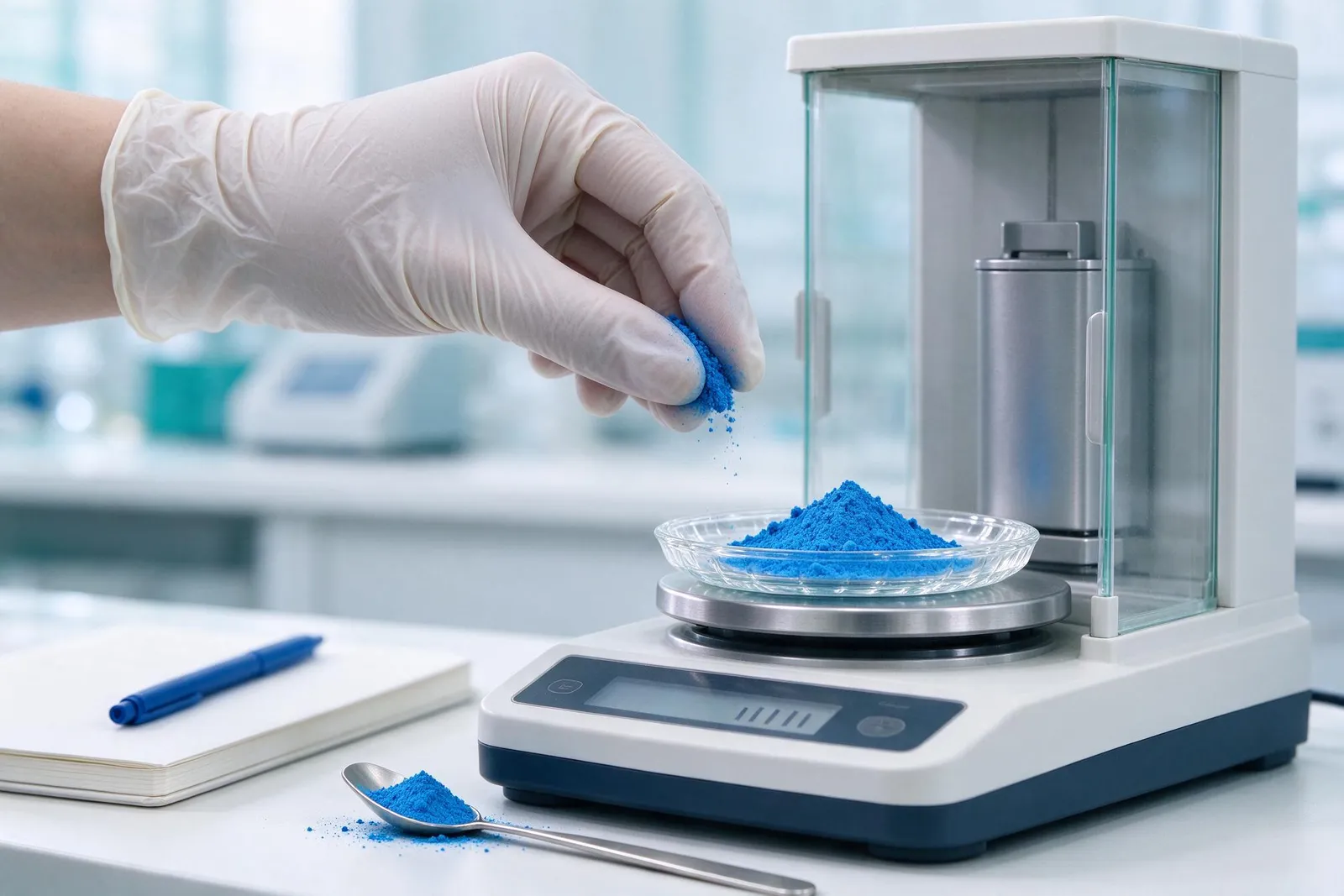
GHK-Cu crystalline powder is hygroscopic. When exposed to ambient warehouse humidity above 60% RH, unprotected powder absorbs moisture and clumps into a sticky dark paste that is difficult to weigh accurately.
At CupraBio, every pack size—from 10 g–100 g R&D vials, 100 g / 1 kg tamper-evident bottles, and 5 kg aluminum-foil barrier bags up to 25 kg fiber drums—is nitrogen-flushed or vacuum-sealed with food/pharma-grade desiccant sachets inside light-blocking layers. You can estimate your exact batch requirement and matching package tier using our GHK-Cu Batch Dosage Calculator.
6. Third-Party Pre-Shipment Verification (SGS / Eurofins)
A trustworthy specialist supplier never hides behind generic "typical" COAs. For bulk commercial orders (1 kg to 25 kg+), CupraBio supports pre-shipment sampling and third-party analytical verification through SGS, Eurofins, or Intertek, as well as 10 g–100 g evaluation samples drawn from the exact same production lot reserved for your bulk order.
Ready to audit our documentation? Download our Representative COA & HPLC Dossier (PDF) or contact our technical sales team) for a lot-specific quotation within 24 hours.
Need GHK-Cu for your formulation?
COA with HPLC chromatogram, MSDS, and quotation within 24 hours.
Related Technical Guides
What Is GHK-Cu (Copper Tripeptide-1)? Molecular Structure, Stoichiometry & Cosmetic Mechanism Guide
Complete technical guide to GHK-Cu (INCI: Copper Tripeptide-1): tridentate Cu2+ coordination chemistry, 1:1 vs 2:1 stoichiometry facts, CAS 49557-75-7 / 89030-95-5 specs, and cosmetic dosing.
GHK-Cu Cosmetic Formulation & Stability Guide: pH Window (5.5-7.5), Chelator Incompatibility & Cold-Process Addition
Why do copper peptide serums turn green or lose viscosity? Master GHK-Cu formulation stability: pH 5.5-7.5 buffering, avoiding EDTA/L-ascorbic acid/carbomers, <40°C addition, and storage rules.
GHK-Cu CAS 49557-75-7 (Acetate) vs. CAS 89030-95-5 (Free Base): Technical Comparison for Formulators & Buyers
Side-by-side comparison of GHK-Cu Acetate (CAS 49557-75-7) and Free Base (CAS 89030-95-5): molecular weight, acetic acid content, aqueous pH buffering, Cu2+ stoichiometry, and global INCI compliance.